

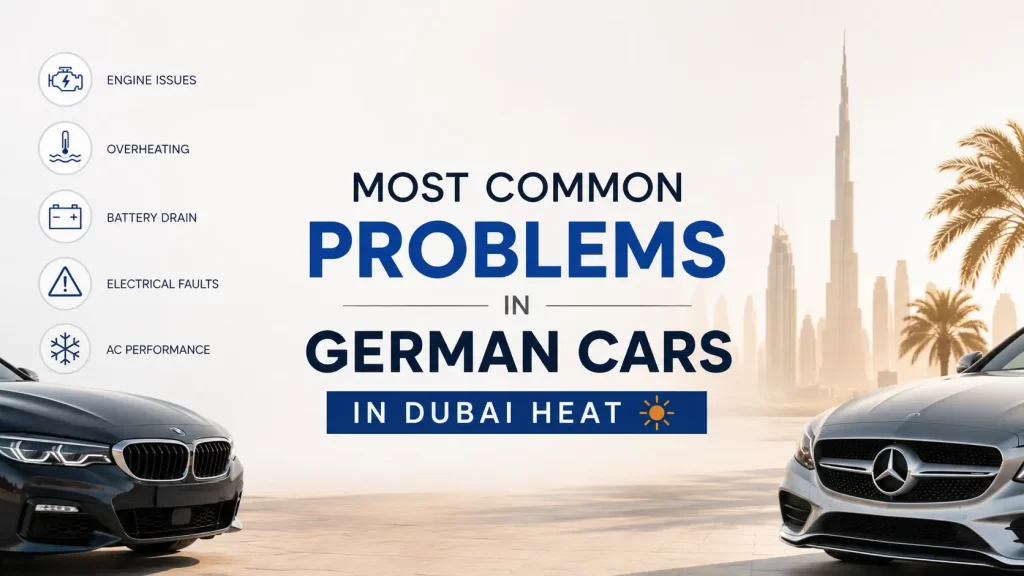
Dubai has one of the highest concentrations of German cars in the world. BMW, Mercedes-Benz, Audi, Volkswagen, and Porsche are everywhere — on Sheikh Zayed Road, in mall parking lots, and cruising through Al Quoz. It makes sense. German vehicles offer performance, comfort, and engineering that few brands can match.
But Dubai’s climate is a different story. Temperatures regularly hit 45°C to 50°C in summer. Add traffic jams, sand, long highway drives, and you have conditions that put serious strain on even the most precisely engineered vehicles.
German cars are built for European roads and weather. They weren’t designed with the Gulf’s heat in mind. This doesn’t mean they fail — it means they need more attention, faster.
This guide covers the most common problems German cars face in Dubai’s heat, why they happen, and what you can do about them.
Why Dubai’s Climate Is Challenging for German Cars
Before getting into specific problems, it helps to understand what exactly Dubai throws at your car.
Extreme summer heat is the obvious one. Surface temperatures on tarmac can exceed 60°C. Engine bays heat up significantly faster than in Europe, and cooling systems work much harder just to maintain normal operating temperatures.
Stop-and-go traffic makes things worse. On roads like Al Khail Road or near Downtown Dubai, cars idle for extended periods. The engine generates heat, but without airflow from movement, the cooling system has to do all the work alone.
Sand and dust are a year-round issue. Fine desert particles get into air filters, AC evaporators, brake components, and sensors. Over time, they accelerate wear in ways that most European drivers never deal with.
Long-distance driving between Emirates at high speed also stresses engines, transmissions, and turbochargers beyond what a typical European commute would.
Together, these factors create a challenging environment that surfaces the weaknesses of even premium German engineering.
Engine Overheating Problems
Overheating is one of the most reported issues with German cars in Dubai. BMW N-series engines, Mercedes M-class units, and Audi’s TFSI family all have cooling systems designed for moderate European climates. In 45°C heat, they’re under constant pressure.
Common causes include:
- Coolant leaks from rubber hoses that degrade faster in high heat
- Thermostat failure — the thermostat controls when coolant flows; if it sticks closed, the engine overheats quickly
- Radiator blockage from dust accumulation, which reduces heat dissipation
- Water pump wear, which reduces coolant circulation efficiency
Warning signs to watch for:
- Temperature gauge rising above normal range
- Steam from under the hood
- Loss of cabin heating (counterintuitively, this can signal low coolant)
- Sweet-smelling exhaust or white smoke
If you see any of these signs, pull over and don’t ignore them. Continued driving on an overheating German engine — especially BMW’s aluminum blocks — can lead to head gasket failure, which is a costly repair.
Air Conditioning Performance Issues
This one hits differently in Dubai. A working AC isn’t optional — it’s essential. And in German cars, the AC system is closely integrated with the vehicle’s electrical architecture, which means problems are often more complex than a simple refrigerant top-up.
What typically goes wrong:
- Compressor wear from running continuously for months at maximum load
- Refrigerant loss through micro-leaks in hoses and fittings that expand and contract with temperature changes
- Clogged evaporator from dust accumulation — this reduces airflow and cooling efficiency
- Condenser blockage from desert sand reducing heat exchange capacity
Many owners notice the AC blowing warm or only slightly cool air, especially at low speeds or during idling. For car AC repair and electrical services in Dubai, regular annual servicing is the most effective prevention.
Electrical and Sensor Failures
Modern German cars are heavily reliant on electronics. A BMW 5 Series or Mercedes E-Class has dozens of control units managing everything from adaptive suspension to lane-keeping assists. In Dubai’s heat, these systems are under consistent thermal stress.
Common electrical issues include:
- Battery failure — heat degrades battery cells faster than cold. Most German car batteries in Dubai need replacement every 2–3 years, compared to 4–5 years in Europe
- Sensor malfunctions — parking sensors, temperature sensors, oxygen sensors, and crankshaft position sensors all fail faster in high heat
- ECU (Engine Control Unit) errors — excessive heat can cause intermittent ECU faults that trigger warning lights without an obvious mechanical cause
- Wiring insulation cracking — UV exposure and heat dry out plastic insulation, leading to shorts
Random warning lights appearing on your dashboard — especially in summer — often point to a heat-related electrical fault. This is why German car diagnostics in Dubai need manufacturer-level scan tools, not just a basic OBD reader. Generic scanners often miss brand-specific fault codes in BMW’s ISTA system or Mercedes’ XENTRY.
Oil Leaks and Fluid Problems
German car engines use rubber gaskets and seals that are designed to expand and contract within a specific temperature range. Dubai’s extreme heat pushes beyond that range, accelerating deterioration.
What this leads to:
- Valve cover gasket leaks — one of the most common issues on BMW N52 and N54 engines
- Oil cooler seal failures on Mercedes diesel and petrol units
- Crankshaft and camshaft seal leaks from prolonged heat exposure
- Brake fluid degradation — high ambient temperatures lower brake fluid boiling points, which can affect braking performance on long highway drives
You might notice oil spots under your parked car or smell burning oil near the engine bay. These leaks might start small but worsen quickly in summer heat.
Using the correct grade of synthetic oil matters too. BMW Longlife and Mercedes MB-approved oils aren’t marketing — they’re formulated for the thermal tolerances these engines require. For more detail on how common Mercedes problems manifest in Dubai’s climate, the specific failure patterns are worth understanding before a problem develops.
Suspension Wear and Rough Road Conditions
German car suspensions are tuned for precision and comfort — but that precision comes with tighter tolerances. Dubai’s road conditions, while generally good, include speed bumps, construction diversions, and occasional desert track driving that create cumulative wear.
Common suspension problems:
- Control arm bushings wear out faster due to combined heat and road vibration — particularly on Audi and BMW models
- Shock absorbers degrade from repeated temperature cycles and the added stress of heavy braking and acceleration in traffic
- Air suspension failures on Mercedes S-Class and GL-Class are common — the compressors run harder in heat, and air bags crack faster
Signs include pulling to one side, knocking sounds over bumps, and uneven tyre wear. Don’t ignore these — worn suspension affects both tyre longevity and steering control.
Transmission Stress in Dubai Traffic
Automatic transmissions in German vehicles are engineered for efficiency. But efficiency drops when heat rises. Dubai’s rush-hour traffic — on E11, on Sheikh Mohammed Bin Zayed Road — involves long periods of stop-and-go that build heat in the transmission fluid.
What happens over time:
- Transmission fluid breaks down faster in high heat, losing its viscosity and protective properties
- Torque converter clutches wear prematurely
- Valve body failures become more common on ZF gearboxes, which are used across BMW, Audi, and Porsche models
- DSG transmission hesitation and shudder in Volkswagen and Audi is particularly common when fluid service is overdue
Transmission fluid should be changed more frequently in Dubai than the manufacturer’s standard interval suggests. A good rule of thumb is every 40,000–50,000 km for vehicles driven in hot urban traffic. An annual car service package in Dubai that includes transmission checks helps catch these issues before they escalate.
Turbocharger and Performance System Issues
Nearly every modern German performance vehicle — whether it’s an Audi A4 TFSI, a BMW 340i, or a Mercedes C300 — uses a turbocharged engine. Turbos generate enormous heat, and proper cooling after driving is essential.
Dubai-specific turbo problems:
- Turbo oil feed blockage from coking — when a hot engine is shut off too quickly, residual oil in the turbo bakes and forms carbon deposits
- Intercooler efficiency loss from heat soak — the intercooler works to reduce intake air temperature, but its efficiency drops significantly when ambient air is already 45°C+
- Boost leaks from heat-softened hoses and couplers
If your German car feels slower than it should, or you notice a hissing sound under acceleration, these are worth investigating quickly. Turbo replacements are among the more expensive repairs on German vehicles.
How Owners Can Prevent These Problems
Prevention is straightforward. Most of these issues become serious only when regular maintenance is skipped or delayed.
Practical steps:
- Service every 10,000 km or sooner in summer — don’t rely on the oil life monitor alone in Dubai’s heat
- Check coolant level and quality every 3 months — degraded coolant loses its anti-corrosion and heat transfer properties
- Service the AC before summer (April–May) — replace the cabin filter, check refrigerant, and clean the evaporator
- Change transmission and brake fluid more frequently — heat degrades both faster than manufacturers’ standard intervals assume
- Let the engine idle for 1–2 minutes before shutting off after a highway drive — this protects the turbocharger
- Park in shade wherever possible — even 10°C less ambient heat makes a real difference to battery and seal longevity
For a structured maintenance approach, an annual car service contract in Dubai covers scheduled checks across all these systems, making it easier to stay ahead of wear.
Why Regular Diagnostics Matter
German vehicles communicate faults through their onboard systems, but not all faults trigger the engine warning light. Some are stored as pending faults that only appear on a full diagnostic scan.
Running a diagnostic scan every 6 months — even when nothing seems wrong — is one of the best investments a German car owner in Dubai can make. It catches early signs of sensor wear, cooling system stress, and electrical faults before they become breakdowns.
The key is using brand-compatible diagnostic tools. Generic OBD readers don’t access the full fault memory on BMW’s ISTA, Mercedes’ XENTRY, or Audi’s ODIS systems. You need a workshop that understands the specific architecture of your vehicle. This is one of the core reasons German cars require specialized mechanics in Dubai — the diagnostics alone require investment and training that most general garages don’t have.
Frequently Asked Questions
Why do German cars struggle in Dubai heat? German vehicles are engineered for European climate conditions. Dubai’s heat — regularly exceeding 45°C — puts extra strain on cooling systems, rubber seals, batteries, and electronics beyond their intended operating range. They don’t fail easily, but they do require more frequent attention than in cooler climates.
Are German cars reliable in UAE weather? Yes, but reliability depends heavily on maintenance frequency. A well-maintained German car in Dubai performs excellently. One that follows European service intervals without adjustment to the UAE climate will develop problems faster.
What is the most common German car problem in Dubai? Overheating-related issues and AC compressor wear are the most frequently reported. Electrical sensor faults and oil leaks from degraded gaskets follow closely.
How often should German cars be serviced in Dubai? Every 10,000 km is a practical baseline in Dubai’s heat, rather than the 15,000–20,000 km intervals sometimes recommended for cooler climates. AC servicing should be done annually before summer.
Can heat damage German car electronics? Yes. Battery degradation, ECU glitches, and sensor failures are all heat-related issues that occur more frequently in the Gulf compared to Europe. Parking in shade and keeping the electrical system in good condition helps extend component life.
Do German cars require special diagnostics? They do. BMW, Mercedes, Audi, and Volkswagen all use proprietary diagnostic protocols that standard OBD tools can’t fully access. Proper fault reading requires brand-compatible software and experienced technicians.
How can I prevent overheating in my German car? Check coolant level and quality regularly, service the cooling system every 2 years, avoid idling for extended periods without shade, and get a diagnostic scan before summer. If the temperature gauge rises even slightly above normal, investigate immediately rather than waiting.
Are German cars expensive to maintain in Dubai? More expensive than Japanese cars, yes — but manageable with a consistent maintenance schedule. Preventive care is significantly cheaper than reactive repairs. A structured service plan helps keep costs predictable.
Conclusion
German cars are genuinely well-built. In Dubai, that quality holds — but only when the maintenance matches the environment. The heat, dust, and driving conditions here accelerate wear on cooling systems, electronics, seals, and transmissions in ways that European service intervals weren’t designed to account for.
The owners who get the most out of their BMW, Mercedes, Audi, or Volkswagen in the UAE are those who service more frequently, use brand-appropriate fluids and parts, and run regular diagnostics. These aren’t luxuries — they’re what keep a precision-engineered vehicle running as it should in a climate it wasn’t designed for.
If your German car has been showing any of the signs mentioned in this guide, or if it’s been more than 10,000 km since your last service, it’s worth booking a proper check-up before the summer heat peaks.