

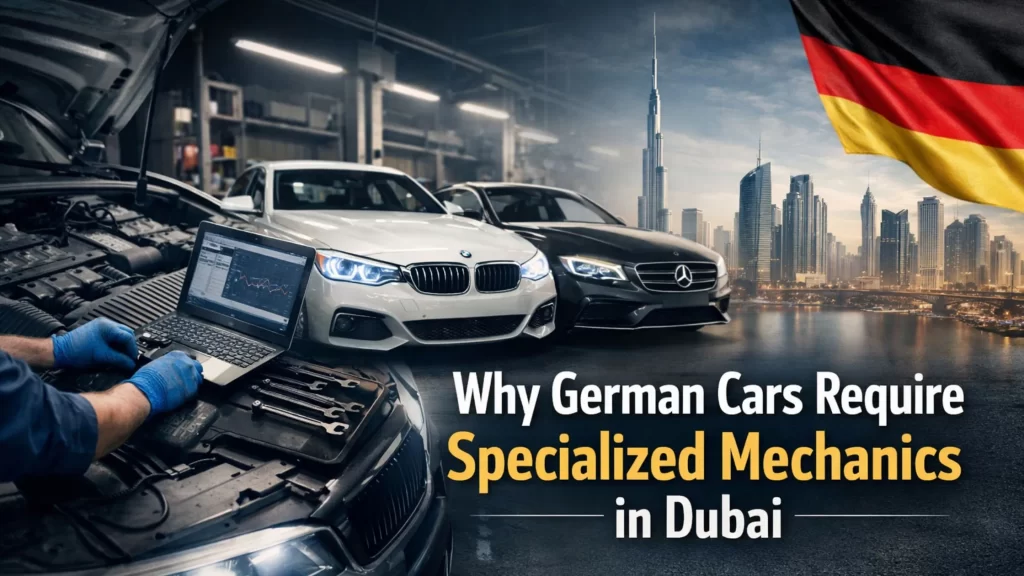
Dubai has one of the highest concentrations of German cars in the world. BMW, Mercedes-Benz, Audi, Volkswagen, and Porsche are everywhere — on Sheikh Zayed Road, in residential neighborhoods, and in shopping mall parking lots. It makes sense. German vehicles deliver performance, comfort, and prestige. And in a city that values all three, they fit right in.
But owning a German car in Dubai comes with a responsibility that many drivers underestimate: maintenance. These vehicles are not like regular cars. They are built with precision engineering, complex electronics, and tightly integrated systems that demand a specific kind of knowledge to service properly. Taking a German car to a general mechanic — one without brand-specific training or diagnostic tools — often leads to misdiagnosis, unnecessary part replacements, and bigger problems down the road.
That’s why finding a qualified German car mechanic in Al Quoz or anywhere in Dubai matters more than most people realise. This guide breaks down exactly why German vehicles are different, what makes servicing them so technical, and why working with trained specialists protects your car and your wallet in the long run.
German Engineering and Technical Complexity
German automakers have built their reputation on engineering precision. But that precision comes with layers of complexity that set these vehicles apart from most other brands on the road.
Multi-System Integration
Modern German cars don’t operate as a collection of separate parts. Every major system — engine, transmission, braking, suspension, and climate — communicates through a central network of electronic control units (ECUs). A BMW 5 Series, for example, can have over 60 individual ECUs managing everything from fuel injection timing to adaptive headlight angles.
When one system develops a fault, it often triggers responses in others. A small sensor issue in the engine can affect the automatic transmission’s shift behaviour. A fault in the air suspension module can trigger stability control warnings. These systems are designed to work together, and diagnosing them correctly requires someone who understands how they interact — not just how to read a generic fault code.
Proprietary Engineering Standards
German manufacturers each follow their own engineering philosophies. BMW’s approach to engine design differs from Audi’s quattro all-wheel-drive system, which differs again from Mercedes-Benz’s air suspension setups or Volkswagen’s DSG dual-clutch gearbox. Each brand has its own tolerances, fluid specifications, and calibration standards.
A mechanic trained on one brand won’t necessarily have the knowledge needed for another without additional, brand-specific experience. This is why general automotive training simply isn’t enough when working on German vehicles.
Advanced Diagnostics and Technology
One of the biggest differences between German cars and most other vehicles is how they communicate faults. Standard OBD-II readers — the kind you find at general garages or auto parts stores — can pull basic fault codes from almost any modern car. But they only scratch the surface with German vehicles.
Manufacturer-Level Diagnostic Tools
German car diagnostics require manufacturer-level software. BMW uses ISTA (Integrated Service Technical Application). Mercedes-Benz uses XENTRY/DAS. Audi and Volkswagen use ODIS (Offboard Diagnostic Information System). These platforms don’t just read fault codes — they allow technicians to run live data tests, perform guided diagnostics, activate individual components, and reset service functions after maintenance.
Without access to these tools, a mechanic is essentially working with incomplete information. They might see a fault code pointing to a sensor, replace it, and find the problem persists — because the real issue was something the generic scan tool couldn’t detect.
Software Coding and Programming
German vehicles increasingly require software coding after certain repairs. Replacing a battery on a modern BMW, for example, isn’t simply a swap. The car’s battery management system needs to be told the new battery’s specifications so it can charge it correctly. Fail to do this, and the battery will wear prematurely.
Installing a new control module on a Mercedes-Benz requires coding it to the car’s specific configuration. Even something as straightforward as fitting new steering angle sensors often needs calibration through the manufacturer’s software. These aren’t optional steps — they’re part of doing the job properly.
Dubai Climate Challenges for German Cars
German cars were engineered in temperate European conditions. Dubai’s climate is the opposite of that. Summer temperatures exceed 45°C, the sun beats down on metal and rubber for months at a time, and the city’s traffic patterns put engines under sustained load in ways that European driving rarely does.
Thermal Stress on Engines and Cooling Systems
The combination of extreme heat and stop-and-go traffic is one of the harshest environments a German engine can face. Turbocharged engines — which are standard on most modern German cars — generate significant heat under load. In Dubai traffic, that heat builds up with limited opportunity for the engine to cool down between bursts of acceleration.
Cooling systems in German vehicles need to work harder in this environment. Coolant hoses, thermostats, water pumps, and radiators are all under greater stress. And because German engines run to tighter tolerances than many other vehicles, overheating — even briefly — can cause damage that a more loosely built engine might shrug off.
Impact on Electronics and Rubber Components
Heat affects more than engines. Dubai’s climate accelerates the degradation of rubber seals, gaskets, and hoses throughout the vehicle. It also stresses the electronics. German cars rely heavily on sensitive sensors, wiring harnesses, and control modules that don’t always tolerate extreme heat as well as the mechanical components around them.
Drivers in Dubai often notice issues with sensors, air conditioning compressors, and electrical gremlins that are directly related to prolonged heat exposure. Identifying these problems quickly and correctly requires a technician who knows what Dubai’s climate does to German vehicles specifically.
Long Highway Drives and Motorway Loads
Weekend trips to Abu Dhabi, Ras Al Khaimah, or Al Ain are common for Dubai residents. High-speed motorway driving over long distances puts a different kind of stress on German vehicles — particularly turbocharged engines that are generating sustained boost, gearboxes cycling through shifts, and tyre pressure that changes with road temperature. All of these factors need to be considered when servicing a German car in the UAE.
Precision Components and Maintenance Requirements
German cars are built to closer tolerances than most other vehicles. This is part of what makes them perform so well. But it also means that maintenance needs to be done with the same level of precision.
OEM-Spec Fluids and Parts
Using the wrong engine oil in a German car isn’t just a minor issue — it can damage the engine over time. BMW, for example, requires specific oil approvals (such as BMW Longlife-04 or LL-17 FE+) that are formulated to work with their engine designs and emission systems. Running a non-approved oil can affect fuel injectors, turbocharger performance, and particulate filter function.
The same applies to coolant, brake fluid, and transmission fluid. German manufacturers specify exact fluid standards, and deviating from them — even with high-quality alternatives — can cause premature component wear.
Torque Specifications and Assembly Standards
When German cars are disassembled for repairs, reassembly needs to follow manufacturer torque specifications precisely. Over-tightening or under-tightening bolts in a German engine or suspension system can lead to leaks, premature wear, or structural failure. Trained technicians work with calibrated torque wrenches and follow technical service bulletins from the manufacturer — something a general mechanic may not have access to or be aware of.
Why Experience Matters When Servicing German Cars
Technical knowledge and the right tools are critical. But experience matters just as much. A technician who has worked on hundreds of German vehicles develops an instinct for how these cars behave, what fails first, and where to look when something isn’t right.
Brand-Specific Failure Patterns
Every German car model has known weaknesses and common failure points. BMW N20 and N55 engines have documented issues with timing chain guides. Volkswagen DSG gearboxes have specific maintenance requirements that, when missed, lead to expensive repairs. Audi’s air suspension components follow predictable wear patterns in hot climates.
A specialist who knows these patterns can identify problems earlier, perform preventive maintenance at the right intervals, and advise owners before small issues become expensive ones.
Repair Accuracy and First-Time Fixes
A correctly diagnosed car gets fixed right the first time. This sounds obvious, but it matters a great deal with German vehicles where labour costs are higher and components are precision-engineered. A wrong diagnosis leads to unnecessary parts being replaced, while the actual problem remains. A trained specialist narrows down the fault accurately — saving time, money, and unnecessary wear on the vehicle.
Common Systems That Require Specialist Knowledge
German Transmission Systems
German automakers produce some of the world’s most advanced automatic and dual-clutch transmissions. BMW’s ZF 8-speed, Mercedes-Benz’s 9G-TRONIC, Volkswagen’s DSG — these are sophisticated units with complex electronic controls and very specific fluid and service requirements. Servicing them incorrectly can cause shuddering, delayed shifts, or complete gearbox failure. Specialists know the correct service intervals, fluid specifications, and adaptation procedures that keep these transmissions working properly.
Turbocharged Engines
Virtually all modern German cars use turbocharged petrol or diesel engines. Turbos require proper lubrication and need time to cool down after hard driving. In Dubai’s heat, turbo care becomes even more important. Specialists understand the signs of turbo wear, the importance of oil change intervals, and how heat cycles in a hot climate accelerate certain failure modes.
Suspension Engineering
German cars use advanced suspension setups — from BMW’s double-wishbone front suspension to Mercedes-Benz’s multi-link rear setups and Porsche’s sophisticated adaptive dampers. Some models use electronically controlled air suspension that needs specialist calibration after repairs. Incorrect alignment or improper suspension work affects handling, tyre wear, and ultimately safety.
Advanced Electronics and Driver Assistance Systems
Modern German vehicles come loaded with advanced driver assistance systems — lane-keeping assist, adaptive cruise control, blind-spot monitoring, and more. These systems rely on cameras, radar sensors, and ultrasonic sensors that need calibration after windscreen replacement, front-end repairs, or collision work. Calibrating these systems without the right equipment leads to systems that don’t function correctly — and that’s a safety issue.
How Specialized Knowledge Prevents Costly Repairs
Catching a problem early is always cheaper than fixing the damage it causes when left unattended. This is true for any car, but especially for German vehicles where components interact closely.
A water pump failure in a German car, if caught early, is a manageable repair. If it leads to overheating because nobody spotted the early warning signs — elevated coolant temperatures, minor coolant loss, slight noises from the pump — the result could be a warped cylinder head or blown head gasket. That’s a repair that costs many times more.
The same principle applies to timing chain wear, differential issues, and electronic module faults. Specialists know what early warning signs look like and how German diagnostic software reports developing faults before they reach critical levels. General mechanics often only see the problem after it has already caused secondary damage.
Proper german car diagnostics in Dubai also help owners make informed decisions about maintenance timing — knowing when a component is nearing the end of its service life versus when it can safely run for another service interval.
Conclusion
German cars remain among the best vehicles on the road — but they perform best when they’re looked after properly. In Dubai, where the climate pushes every component harder, that need for proper maintenance becomes even more important.
The engineering complexity, the precision components, the manufacturer-specific software — all of it points to the same conclusion. German vehicles need technicians who know them inside and out. Someone who has seen the same faults on the same models, who works with the right diagnostic tools, and who understands what Dubai’s heat and traffic actually does to these cars over time.
Choosing the right specialist isn’t just about fixing a problem when it appears. It’s about keeping the vehicle in the condition it was designed to perform in — reliably, safely, and for the long term.
FAQs
1. Why do German cars require specialist mechanics?
German vehicles use proprietary engineering, manufacturer-specific diagnostic software, and tightly integrated electronic systems. Servicing them correctly requires brand-specific training, specialist tools, and experience with how these vehicles behave under real-world conditions — including Dubai’s extreme heat. A general mechanic without this background can misdiagnose faults or use incorrect parts and fluids, leading to bigger and more expensive problems.
2. Are German cars expensive to maintain in Dubai?
Maintenance costs for German cars in Dubai are higher than for Japanese or Korean vehicles, mainly because of the cost of OEM-spec parts and the need for specialist labour. However, the real cost factor is incorrect maintenance — using wrong fluids, missing service intervals, or misdiagnosing faults can turn a manageable service into a major repair bill. Working with a qualified specialist keeps maintenance costs predictable and avoids unnecessary expenses.
3. What diagnostic tools are needed to service German cars?
Each German brand uses its own diagnostic platform. BMW requires ISTA, Mercedes-Benz uses XENTRY/DAS, and Volkswagen Group vehicles use ODIS. These systems go far beyond generic OBD-II readers — they allow technicians to run live system tests, perform guided diagnostics, code new components, and reset service functions after maintenance. Without access to these tools, accurate diagnosis of German vehicles is not possible.
4. How often should German cars be serviced in the UAE?
German manufacturers provide service intervals for their vehicles, but Dubai’s climate often means more frequent checks are advisable. Engine oil should be inspected more regularly given the heat and traffic conditions. Coolant, brake fluid, and air filter condition also deserve closer attention in hot climates. As a general guide, an annual full inspection alongside the manufacturer’s recommended service intervals is a sensible approach for UAE conditions.
5. Are German vehicles reliable in Dubai’s hot climate?
German cars can be very reliable in Dubai when they are serviced correctly and regularly. The key is addressing the specific demands of the environment — more frequent coolant system checks, attention to rubber and seal condition, and monitoring of electronics that are sensitive to heat. Vehicles that receive proper, specialist maintenance in line with UAE driving conditions perform well over many years. Problems arise when maintenance is delayed, incorrect fluids are used, or faults are not diagnosed early.